If You Don't Do This, Your Strawberry Skin Could Become Permanent After Pregnancy Ends

All findings were carefully reviewed for relevance and safety in pregnancy
The Patient Who Changed Everything
She was six months pregnant when she came to see me, arms folded tightly, skin flushed from embarrassment rather than heat. “I thought these bumps would go away after my first trimester,” she said quietly, “but they've only gotten worse.”
She'd already seen three dermatologists and an esthetician, each blaming hormones, each sending her home with creams that left her arms burning and raw. Her keratosis pilaris, what she called her “strawberry skin”, had spread from her upper arms down to her thighs.

The story was painfully familiar. Harsh scrubs. Strong acids. “Pregnancy-safe” lotions that only dried her skin further. Every failed treatment chipped away at her confidence until she stopped wearing anything that didn't cover her completely.
When she finally rolled up her sleeve, the skin looked rough, inflamed, almost scar-like. “I'm scared it's going to stay like this forever,” she whispered. “Will my skin ever go back to normal?”
The Investigation That Shook My Profession
For years, we'd been treating KP as a surface issue: a buildup of keratin that could simply be scrubbed or medicated away. But that assumption ignored the deeper hormonal reality of pregnancy: shifting estrogen and progesterone levels weaken the skin's natural barrier and disrupt cell turnover.
The result? Keratin plugs that become trapped beneath the surface and inflamed: the early signs of texture that can persist long after childbirth if left untreated.
Traditional treatments weren't just failing these women, they were often making things worse. Strong acids, harsh scrubs, and steroid creams stripped away vital lipids and left the skin more vulnerable, not less.

When we finally applied this new, pregnancy-safe protocol, the change was undeniable. Instead of attacking the surface, we supported the skin's natural repair rhythm, and for the first time, pregnant women began seeing lasting smoothness that continued postpartum.
What I Discovered About Pregnancy Skin Changed My Practice Forever
After analyzing hundreds of pregnancy-related KP cases, I uncovered five critical mistakes that cause hormonal bumps to harden, making post-pregnancy recovery far more difficult.
The 5 Critical Mistakes That Lock In Pregnancy KP

The "Scrub Harder" Trap
During pregnancy, your skin barrier is thinner and more reactive. Every harsh scrub or exfoliating mitt tears at that barrier, sending the body into defense mode and triggering even more keratin buildup. What feels like “deep cleaning” actually grinds the bumps in deeper, making post-pregnancy recovery painfully slow.
The Steroid Cycle
Steroid creams calm redness for a moment, but at a cost. They thin already-delicate skin and blunt its ability to heal itself. Once stopped, inflammation rebounds stronger, and the skin often hardens where it once flared. By the time pregnancy ends, that roughness can feel textured, tight, and impossible to smooth.
Ignoring the Barrier Collapse
KP isn't just clogged pores, it's a barrier in crisis. When hormones strip the skin of lipids, moisture escapes and keratin plugs “cement” beneath the surface. Skipping barrier repair during pregnancy is like trying to patch a leak without sealing the pipe. The damage sets in and lingers long after delivery.
The One-Ingredient Illusion
Pregnant skin doesn't need punishment; it needs precision. High-dose single acids sting, peel, and inflame. Each flare leaves behind stubborn discoloration that's far slower to fade postpartum. KP requires a balanced, multi-path formula that dissolves buildup and rebuilds protection.
Treating the Bumps, Not the System
Those bumps are only the symptom. The real issue is hormonal disruption, inflammation, and a barrier that can't renew itself. When left uncorrected, that imbalance becomes your skin's “new normal,” locking in roughness that outlasts pregnancy.
The Only Clinically Backed Ingredients Proven to Reverse Pregnancy KP
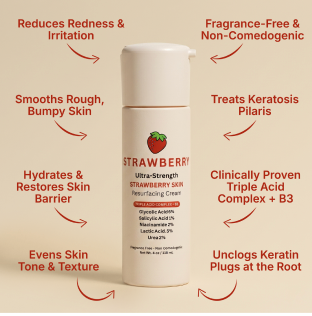
During pregnancy, hormonal shifts slow skin turnover and trap keratin beneath the surface. Most treatments fail because they skip the three ingredients research shows actually work: glycolic acid, lactic acid, and salicylic acid. These gentle acids safely dissolve buildup, restore smooth texture, and prevent the roughness that often sticks around long after delivery. Strawberry is built on this same medical evidence, formulated to work with pregnancy-altered skin, not against it.

The Clinical Breakthrough That Stops Pregnancy KP From Becoming Permanent
Pregnancy changes everything, but it shouldn't take your skin with it. What we discovered is rewriting how women heal: by supporting the barrier, calming inflammation, and dissolving buildup early, we can prevent pregnancy KP from becoming a lifelong mark. Developed under OB-GYN guidance to ensure every insight applies safely during pregnancy.
Glycolic Acid 6%
Loosens trapped keratin plugs before they harden, unveiling smoother skin that can keep renewing itself
Niacinamide 2%
Soothes hormonal inflammation and rebuilds the barrier so bumps fade instead of flare
Urea 2%
Softens thickened texture while drawing in deep hydration, returning the supple feel pregnancy hormones strip away
Lactic Acid 1%
Gently resurfaces dull, uneven skin and helps prevent lingering discoloration after delivery
Salicylic Acid 0.5%
Clears existing blockages at the follicle level, stopping new bumps before they leave lasting marks
Rebecca's 7-Day Transformation
The patient who proved pregnancy-triggered KP doesn't have to leave a lifelong mark
The Burning Finally Stops
Within 24 hours, the redness and sting began to fade. “My skin doesn't feel angry anymore.” The gentle, barrier-supporting acids calmed inflammation and released trapped buildup, the first real sign that her skin was starting to repair itself safely.
The Softening Begins
As her hormones continued to fluctuate, the rough, sandpaper texture began to loosen. Rebecca ran her hand over her arm and exhaled. For the first time, it felt like skin again. Her barrier was finally rebuilding, proof that healing could happen safely even while her body was changing daily.
The Confidence Spark
Halfway through her pregnancy, Rebecca finally felt brave enough to wear a short-sleeved dress to her prenatal appointment. “For the first time, I wasn't focused on hiding my arms,” she told me. The bumps were flatter, the redness softer, proof her skin was healing even as hormones kept shifting. But I reminded her: if she stopped now, those hormonal flare-ups could return and harden into lasting texture after delivery.
The Breakthrough Moment
At her one-week follow-up, Rebecca's transformation was undeniable. Her arms were smooth again, the redness gone, and the bumps that once felt permanent had vanished. “For the first time this pregnancy, I feel like myself again,” she said, eyes welling. It was proof that healing during pregnancy wasn't just possible, it was lasting.
What Other Mothers Are Saying About Their “Pregnancy KP” Transformation
 UntreatedAfter 14 days
I thought my pregnancy ruined my skin.” After months of hormonal flare-ups, my arms looked worse than ever: red, rough, and painful to touch. I tried everything doctors allowed during pregnancy, but nothing helped. Then I found this formula. Within two weeks, my skin was smooth again, and the fear that it would never go back to normal disappeared.
Jennifer K. Age 31 (7 months pregnant)
 UntreatedAfter 10 days
Every doctor told me to ‘wait it out.” I cried every time I looked in the mirror. My KP spread across my upper arms halfway through my second trimester, and I was terrified it would stay forever. This gentle protocol worked without irritation, the first thing that felt safe and actually worked.
Patricia M. Age 35 (Pregnant with her first)
 UntreatedAfter 7 days
I was scared my baby shower photos would capture my worst skin ever.” My arms were so red and bumpy I didn't want to wear the dress I'd bought. By Day 7, everything changed. The bumps flattened, the redness faded, and I felt confident again. Now, I tell every pregnant friend: don't wait, fix it before it becomes permanent.
Sarah T. Age 28 (Third Trimester)
 UntreatedAfter 4 days
I couldn't believe it worked this fast.” My KP always flared during pregnancy, but this time was worse. Nothing felt safe to use. After just four days, the itch, redness, and burning stopped completely. I finally stopped scratching at night. My only regret is not starting sooner.
Emily R. Age 33 (Postpartum, 2 weeks)
Don't Let These Nine Months Leave a Lifelong Mark
Every pregnancy leaves its story, but rough, uneven skin doesn't have to be part of yours. Each day you wait, those hormonal bumps harden and grow tougher to reverse. Start rebuilding your skin's smooth, confident texture now, before it sets in for good.