The Fastest Clinically Proven Way to Get Rid of Strawberry Skin Fast!
 UntreatedAfter 7 days
The Patient Who
Changed Everything
Rebecca walked into my clinic on a Tuesday morning, arms crossed tightly over her chest despite the summer heat. She'd been to four dermatologists before me, each promising to fix her keratosis pilaris, what she called her "strawberry arms."
Her story was heartbreakingly familiar. Aggressive scrubs that left her skin raw and bleeding. Steroid creams that worked for weeks, then stopped. Expensive laser treatments that made the bumps angry and red. Each failed treatment had chipped away at her confidence until she refused to wear anything that didn't cover her arms completely.

"I just want normal skin," she whispered, finally uncrossing her arms to show me the damage. "Why is that so impossible?"
TRY IT NOW - 50% OFFThe KP Investigation That Shook My Profession
I spent the next six months reviewing case files, interviewing colleagues, and studying the latest research on keratosis pilaris pathophysiology. What I found was disturbing.
We weren't treating keratosis pilaris, we were treating our assumptions about it. For decades, the dermatology community had approached KP as a simple "too much keratin" problem. Scrub it off. Burn it off. Medicate it away.

But new research revealed KP is actually a complex interplay of abnormal skin cell turnover, compromised barrier function, and chronic low-grade inflammation. The treatments we'd been prescribing weren't just ineffective, they were making the underlying problem worse.
By addressing the root cause instead of attacking symptoms, we achieved results that traditional treatments couldn't deliver.
TRY IT NOW - 50% OFFWhat I Discovered Changed My Practice Forever
After reviewing hundreds of failed KP treatments, I uncovered 5 fundamental mistakes that 9 out of 10 dermatologists make

The 5 Critical Mistakes Dermatologists Were Making
The "Scrub Harder" Fallacy
Aggressive scrubbing creates microscopic tears, triggering inflammation that makes your body produce MORE keratin as protection. We were literally making the problem worse.
The Steroid Band-Aid Approach
Steroids reduce inflammation quickly but thin the skin and create dependency. When patients stopped, KP returned worse because we never fixed the root cause.
Ignoring the Barrier Breakdown
We attacked keratin plugs while ignoring skin barrier repair. Without fixing the barrier, we were emptying a bathtub with the faucet still running.
The Single-Agent Mistake
High-dose single acids either caused irritation or were too weak to penetrate effectively. KP needs multiple ingredients working together.
Treating Symptoms, Missing the System
We attacked bumpy skin instead of asking why skin cells don't shed properly. KP is a cellular communication problem, not just a keratin problem.

The Only Ingredients Clinically Proven to Clear KP
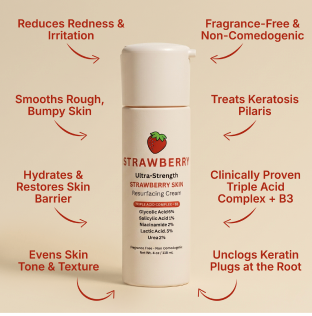
Every lotion, scrub, and prescription failed because they skipped the 3 ingredients science says actually work: glycolic acid, lactic acid, and salicylic acid. These acids dissolve keratin buildup, unclog follicles, and smooth your skin fast. Working with a team of biochemists and frustrated by my own patients' failures, I developed what we now call the “Barrier-First Protocol”, instead of attacking the skin, we support it. Instead of one harsh ingredient, we use five gentle ones that work together.
Glycolic Acid 6%
Dissolves keratin bonds gently while stimulating healthy cell turnover
Niacinamide 2%
Reduces inflammation and strengthens barrier function naturally
Urea 2%
Hydrates deeply while breaking down keratin deposits
Lactic Acid 1%
Promotes cellular renewal while maintaining moisture
Salicylic Acid 0.5%
Penetrates follicles to clear existing blockages
Rebecca's 7-Day Transformation
The patient who started this journey became our first success story
The Irritation Calms
Within 24 hours, Rebecca noticed the chronic burning sensation was subsiding. "My skin doesn't feel angry anymore," she said. The gentle formula was already beginning to soothe her inflamed follicles.
The Softening Begins
The sandpaper texture was starting to soften. Rebecca ran her hand over her arm and smiled, for the first time in months, it didn't feel rough. The keratin plugs were beginning to dissolve.
The Confidence Spark
Rebecca chose a short-sleeved shirt for the first time in two years. "I caught myself not thinking about my arms," she texted me. The visible bumps were noticeably flatter, and the redness was fading.
The Breakthrough Moment
At her one-week follow-up, Rebecca's transformation was remarkable. Her arms were smooth to the touch, the strawberry appearance had cleared, and most importantly, she was wearing a sleeveless dress. "I feel normal again," she said with tears in her eyes.
Rebecca Isn't the Only One Who Said Goodbye to Strawberry Skin
 UntreatedAfter 4 days
As someone with sensitive skin, I was skeptical about trying another treatment. But this formula is so gentle yet effective. No irritation, no burning, just gradual improvement that keeps getting better with consistent use.
Michael R. Verified Purchase
 UntreatedAfter 5 uses
I know this condition is 'harmless' but it's harming my mental health. I've truly tried it all: Amlactin, Cerave, Eucerin, different acids… No success whatsoever.
Christina B. Verified Purchase
 UntreatedAfter 2 uses
After 6 years of avoiding sleeveless tops, I wore a tank dress to my cousin's wedding last weekend. No cardigan, no makeup on my arms, no anxiety. That feeling alone was worth every penny.
Mary H. Verified Purchase